Bali as a Jewellery Ecosystem
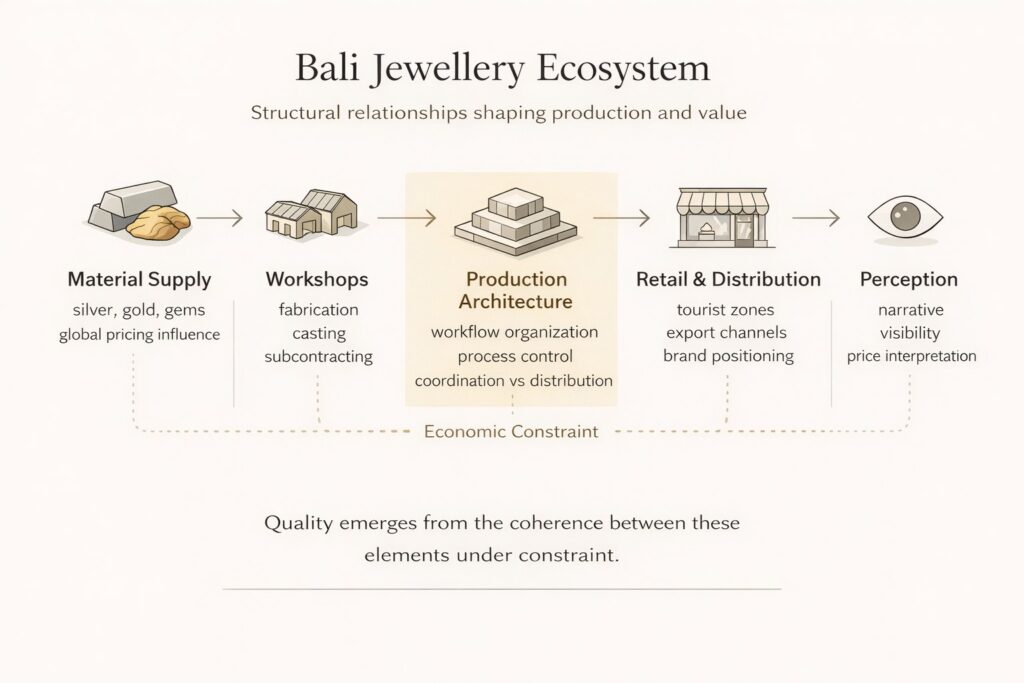
Bali is not a singular jewellery tradition, nor a unified production culture. It is a layered economic ecosystem shaped by tourism, export demand, small-scale craft production, subcontracting networks, and global commodity flows. Jewellery produced and sold in Bali cannot be understood purely as isolated objects. It exists within an interconnected structure of incentives, material supply constraints, labour stratification, and retail positioning.
Unlike centralised manufacturing hubs, Bali’s jewellery landscape is decentralised. Workshops range from small ateliers producing limited handmade pieces to distributed production networks relying on piecework and subcontracted casting. Retail environments vary from export-oriented galleries to tourist-focused storefronts operating under short purchase cycles. These variations are structural features of the ecosystem rather than deviations from a single standard.
The observations in this guide arise from sustained engagement with fabrication, sourcing, and export structures within this environment. They do not attempt to rank producers or defend market segments. Their purpose is analytical: to describe the conditions under which value is formed and durability is determined.
Silver pricing in Bali is influenced by internationally quoted benchmark prices, largely derived from financial commodity markets. However, the price at which physical silver is acquired locally is influenced by additional factors, including distribution structure, taxation, currency exposure, inventory risk, and speculative behaviour. As a result, local purchase prices may diverge meaningfully from widely published global benchmarks.
To evaluate jewellery made in Bali without understanding the surrounding system is to isolate the product from the conditions that shape it. This guide, therefore, situates objects within the economic and production architectures that govern them.
Tourism, Craft, and Global Trade
Jewellery in Bali predates modern tourism and plays an established role within ceremonial, social, and religious contexts. Ritual adornment, temple use, and markers of identity form part of the island’s historical material culture. However, the contemporary jewellery ecosystem visible in retail districts and export markets is structurally linked to tourism and global trade.
A significant portion of retail transactions occurs during short-term visitor cycles, in which purchasing decisions are influenced by time constraints, travel context, emotional associations with place, and prevailing fashion trends. Jewellery is frequently acquired not only as adornment, but as a material marker of experience shaped by contemporary aesthetic preferences.
This retail environment shapes production priorities, though not uniformly across all producers. Independent designers and export-oriented brands often respond quickly to seasonal demand, visitor preferences, price sensitivity in tourist zones, and global design trends circulating on social media and in wholesale markets. Their collections may shift visibly in alignment with contemporary fashion cycles.
By contrast, more traditional suppliers and long-established workshops often operate on slower aesthetic rhythms. Production may rely on stable design repertoires, inherited techniques, and repeatable patterns that change incrementally rather than seasonally. Continuity can outweigh trend responsiveness.
At the same time, Bali operates within international trade networks. Export orders affect material sourcing, production scheduling, and workshop capacity allocation. Volume-based wholesale production may coexist with small-batch handmade fabrication, often within the same geographic cluster. These parallel demand channels operate under different economic pressures yet draw on overlapping labour pools and supply chains.
The result is a layered system in which tourism economics, fashion cycles, global trade logic, and long-standing cultural practice intersect. What appears externally as a unified jewellery culture is, in practice, the outcome of multiple structural forces operating simultaneously.
Visibility, Perception, and Market Distortion
In a tourism-driven retail environment, visibility does not necessarily correspond to structural depth. Prime storefronts, polished interiors, and strong online presence often reflect marketing capacity and rental economics as much as workshop capability.
Retail geography in Bali is uneven. Areas with concentrated tourist flows incur higher operating costs and shorter purchase cycles. Businesses in these zones must communicate value quickly and clearly. This affects which pieces are displayed, how they are described, and how pricing is positioned. Visibility becomes closely linked to location strategy rather than production architecture.
Perception is shaped by language. Terms such as handmade, artisan, traditional, or sustainable carry weight, yet their practical meaning varies significantly. In short retail interactions, narrative frequently replaces detailed explanations. Buyers rarely see production methods, supply chains, or durability thresholds. Perception forms before structural understanding.
Digital platforms reinforce this pattern. Social media presentations, influencer visibility, and review systems create reputational hierarchies that do not necessarily align with workshop structure or technical standards. Strong online visibility does not automatically indicate superior fabrication discipline, and limited digital presence does not imply structural weakness.
These distortions are not unique to Bali. They are features of retail environments where presentation and narrative operate independently of production architecture.
Why Object-Level Evaluation Is Not Enough
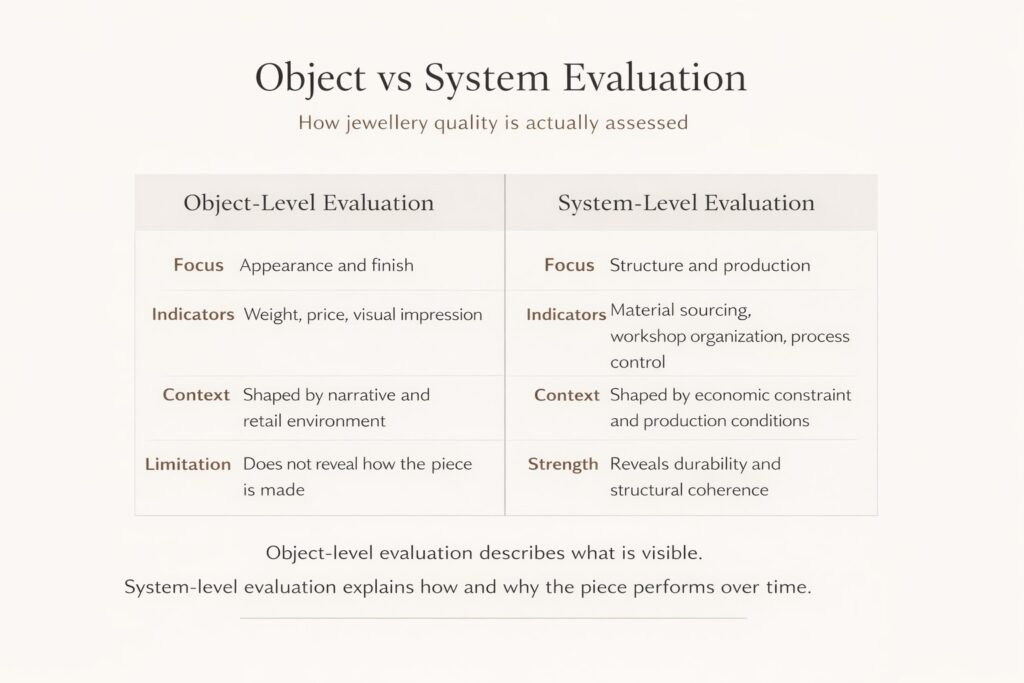
Jewellery is commonly evaluated as a finished object. Weight, surface finish, stone appearance, stamping, and immediate visual impression provide initial information. Yet these indicators describe surface attributes rather than structural formation.
Two pieces that appear similar in weight and finish may originate from entirely different production architectures. One may be produced within a coordinated workshop system in which processes are internally monitored, and durability margins are consciously calibrated. Another may result from distributed subcontracting shaped by time compression, margin targets, or rapid retail cycles. The finished surface does not disclose workflow organization, alloy preparation, quality control thresholds, or sampling discipline.
Price comparison suffers from the same limitation. Without understanding the metal-acquisition structure, workshop scale, distribution layers, and retail overhead, a numerical comparison is incomplete. A higher price may reflect operating structure and brand positioning rather than fabrication superiority. A lower price may reflect reduced intermediary layers rather than compromised material integrity.
For these reasons, object-level evaluation, while intuitive, is insufficient. Meaningful assessment requires situating jewellery within material sourcing systems, workshop architecture, economic incentives, and market layers. Later sections of this guide introduce a structured framework for separating these variables, making evaluation analytical rather than reactive.
Quality in jewellery is defined by the coherence between material, structure, and production under economic constraint, rather than by surface appearance, price, or narrative.
About the Author
Direct engagement with Bali’s jewellery production environment since 1997 informs the observations presented in this work. The author, Laurent Leger, has been involved in design development and prototyping, hands-on fabrication, gemstone sourcing, sampling processes, export coordination, and retail positioning across both local and international markets.
Over time, this work has intersected with multiple layers of the ecosystem: workshop production, wholesale transactions, brand development, and direct consumer retail in tourist-facing districts. Exposure includes bench fabrication in both 950- and 925-silver contexts, as well as the operational realities of casting, subcontracting, and hybrid production systems.
This perspective is grounded in sustained participation rather than external commentary. The intention of this work is analytical, not promotional: to clarify how jewellery production in Bali is shaped by its economic and material environment, and how quality may be evaluated within that context.